Why we repeat the love we learned as children.
Why we repeat the Love we learned as children.
- and how to heal the love we never got
Have you ever looked back on a relationship, a friendship, or a family bond and wondered why you stayed so attached to something that caused you so much confusion? Perhaps you missed someone who rarely appreciated you. Perhaps you kept forgiving someone who let you down, kept trying to understand someone who never seemed interested in understanding you, or kept believing that one more conversation, one more kind gesture, might finally bring you the connection you had been longing for.
We usually explain this by saying that people need love, approval and belonging. Of course we do. But I believe something more layered is often happening underneath. Sometimes we are not simply searching for love. We are trying to recreate, protect, and eventually resolve the definition of love that our Inner Child learned a long time ago. That distinction matters more than it first appears, because the Inner Child does not just remember childhood. It learns from it, and what it learns becomes the blueprint we carry into every relationship that follows, until we consciously build something new.
The child who had to make sense of love
Children arrive in the world completely dependent on the people around them, not only for food and shelter but for emotional regulation, reassurance and belonging. Because of that dependency, a young child becomes remarkably attentive to the people they rely on. They notice facial expressions, tone of voice, approval, criticism, distance, affection, silence, withdrawal and inconsistency, and from all of it they are constantly learning what keeps people close and what makes them pull away.
Crucially, a child tends to make these lessons personal. A young child cannot easily think that a parent is emotionally unavailable because of their own unresolved history, or that a father is critical because he has never learned to manage his own sense of inadequacy. Instead the child draws conclusions about themselves. There must be something wrong with me. I need to try harder. I mustn’t upset people. I have to be good. I shouldn’t need too much. These are not passing thoughts. They become the beginning of an internal emotional architecture that quietly shapes everything that follows.
When love becomes an equation
If affection reliably follows achievement, a child may come to believe that love means performing well. If connection mostly arrives during distress, love comes to mean suffering and rescue. If affection is unpredictable, love means uncertainty and waiting. If criticism comes bundled with parental involvement, love means correction. If keeping the peace requires suppressing your own needs, love means self-sacrifice, and if approval has to be won again and again, love means proving your worth.
None of these equations were consciously chosen. They were adaptations, the best conclusions a developing mind could reach while trying to survive its emotional environment. As development continues, the child gradually absorbs the messages, expectations and judgements of the significant adults around them, and this becomes the developing Inner Critic.
This is how the Filial Psyche begins to take shape. The Inner Child carries the feeling. The Inner Critic carries the rule for managing it. When the Child says I’m frightened they might leave, the Critic replies then try harder. When the Child says I don’t feel important, the Critic answers make yourself useful. This is where childhood adaptation quietly becomes adult repetition.
The Filial Loop
The Filial Loop describes the self-reinforcing relationship between the vulnerable Inner Child and the protective but often punishing Inner Critic, and how that unique relationship builds.
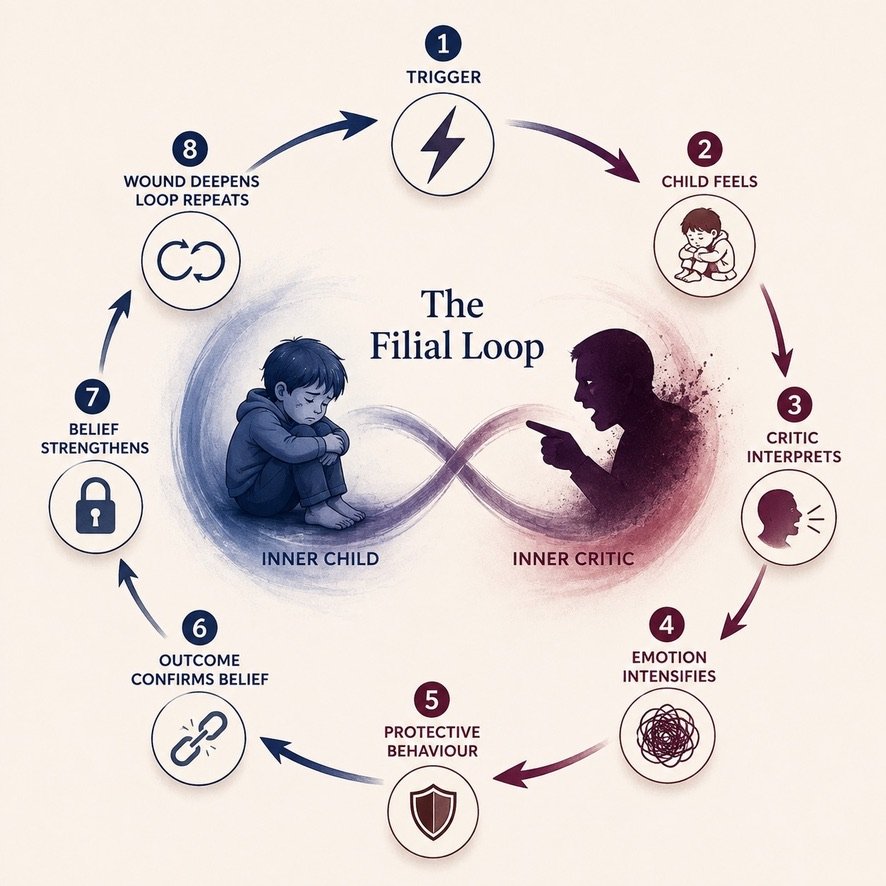
Something happens out in the world. A partner grows distant, a friend seems irritated, someone withdraws their affection, and the Inner Child feels the impact immediately. I’m frightened. I’m hurt. I don’t feel important. Then the Inner Critic interprets that distress through the old childhood rule. You’re going to lose them. You’ve done something wrong. Try harder. Don’t upset them. The Critic’s response increases the Child’s distress, and the increasingly distressed Child gives the Critic further evidence that something must be wrong.
An external trigger leads to Inner Child distress, which leads to Inner Critic interpretation, which leads to increased distress and increased Critic activity. The loop feeds itself, and this helps explain why certain relationships can feel so overwhelmingly powerful.
When intensity becomes evidence
One of the most important consequences of the Filial Loop is that emotional intensity can get mistaken for emotional truth. If someone makes us anxious, we assume they must matter enormously. If we cannot stop thinking about them, we conclude we must love them deeply. If losing them feels unbearable, we assume the relationship must be profoundly important, and if we constantly have to work for their affection, getting it feels especially valuable. But emotional intensity doesn’t necessarily measure the quality of a relationship. Sometimes it measures how strongly the relationship has activated the Filial Psyche.
This gives us an important principle to hold onto. The intensity of an emotion tells us how powerfully something has been activated. It does not necessarily tell us how true the underlying belief is. A person who repeatedly triggers our fear of abandonment can feel far more compelling than someone who is simply, consistently available. Someone difficult to please can feel more significant than someone who accepts us. Unpredictability can feel more exciting than reliability, and we may recognise as adults that something is unhealthy while our Inner Child remains magnetically drawn to it, because the Child recognises the emotional landscape. It has been there before.
Familiarity is not compatibility
We don’t usually repeat painful relationships because we consciously want pain. We repeat familiar emotional patterns because familiarity creates recognition, and recognition can disguise itself as compatibility. When the Inner Child meets an emotionally unavailable person, part of it thinks I know this. It meets a demanding person and thinks I know how to survive this. It meets an inconsistent person and thinks I understand these rules. What feels like chemistry can sometimes contain a great deal of psychological recognition.
The relationship feels significant because it activates an old template, and while the Adult part of you may quietly ask why am I still trying, the Inner Child is often silently answering because maybe this time I can finally make the story end differently. This is where the Filial Loop becomes especially powerful, because we stop relating only to the person in front of us and start trying to resolve something much older through them.
The Inner Critic as protector
Within the Filial Psyche it matters that we don’t simply demonise the Inner Critic. It developed for a reason, learning rules designed to protect the Child. Don’t be selfish. Don’t upset people. Work harder. Don’t show weakness. Keep everybody happy. What can sound like hostility often began as protection. The problem is that the Critic keeps applying childhood solutions to adult circumstances, without quite registering that the circumstances have changed. So when the Inner Child becomes frightened in an adult relationship, the Critic reaches for the same old strategies of people pleasing, performing, explaining, rescuing, apologising and suppressing your own needs. The intention is protection. The consequence is often re-wounding, because the Child is effectively told once again that their feelings are dangerous, their needs are inconvenient, and connection has to be earned. The Filial Loop ends up perpetuating the very wound it was trying to prevent.
The identities we build around love
Over time these patterns become more than behaviours. They become identities. We become the rescuer, the peacekeeper, the dependable one, the one who never gives up, the one who forgives, the one who doesn’t need very much. These identities are often socially rewarded, and people describe us as generous, caring, loyal or selfless, which sometimes we genuinely are. But therapy asks a harder question. What happens if I stop doing them? If saying no produces guilt, setting a boundary produces anxiety, asking for something produces shame, or letting someone else be disappointed produces panic, we are probably dealing with more than kindness. We are encountering the Filial Psyche, and once again the Child fears the consequences, the Critic activates its old rules, and the Filial Loop begins.
Why insight isn’t enough
Many people arrive in therapy already understanding their childhood remarkably well. They can explain why they people please, why rejection frightens them, and why a parent was emotionally unavailable, and yet the pattern continues anyway. Understanding the Filial Loop is not the same as interrupting it. Insight gives us a map, but healing requires a new internal relationship, and this is where the Inner Nurturing Parent becomes essential.
From the Filial Loop to the Healing Loop
The purpose of this work is not to silence the Inner Critic or to remove the Inner Child’s vulnerability. It is to build a different internal relationship, one in which the Inner Child has an emotionally responsive parent, the Inner Critic has some supervision, and the Adult becomes capable of acting from present day reality rather than automatically obeying old adaptations. Together these create what I call the Healing Loop.
Imagine a partner becomes distant. In the old Filial Loop, the Inner Child feels they’re going to leave me, the Critic insists you’ve done something wrong, fix it, message them, and the Child ends up even more frightened.
In the Healing Loop, another voice joins the conversation. The Inner Nurturing Parent says I can see how frightened you are, this feels familiar, you don’t have to deal with this alone anymore, and their distance does not determine your worth. Then the Adult asks what is actually happening here, not what am I frightened is happening, but what evidence exists in the present. Now something different becomes possible. The Child feels held, the Critic no longer has unrestricted authority, and the Adult can make a decision based on current reality rather than an old fear.
A trigger leads to an Inner Child feeling, which leads to Nurturing Parent response, which leads to Adult evaluation, aligned action, and a growing sense of internal safety. That is the Healing Loop, and it too becomes self-reinforcing. Every time the Child feels distress and discovers someone inside responds with compassion instead of criticism, trust grows. Every time the Adult sets an appropriate boundary, the Child learns someone is protecting me. Every time the Critic’s catastrophic prediction gets gently questioned, it learns perhaps I don’t have to work so hard.
Becoming familiar with ourselves
Many of us become extraordinarily familiar with everybody except ourselves. We know what our partner wants, what our parents expect, and how to read a shift in someone’s mood before they’ve said a word, yet ask what do you want, what do you feel, what do you need, and suddenly there’s uncertainty. This isn’t a lack of self-awareness so much as attention that was trained outward a long time ago, because for the Inner Child, understanding other people once increased safety. What do they think became more important than what do I think, and are they okay with me became more important than am I okay with what’s happening. Part of this work is simply reversing that direction of attention, growing curious about our own feelings, values, needs and boundaries, and learning to tell the difference between the Inner Critic’s inherited rules and our own considered Adult judgement.
Self trust is not prediction
Many of us unconsciously define self trust as if I trust myself, I should make the right decision, and beneath that, if I make the right decision, things should turn out well. This creates an impossible contract with life, because no one can guarantee outcomes.
A relationship can fail despite a thoughtful decision. A career change can disappoint us. Someone we trust can still let us down. The Adult understands something the frightened Inner Child struggles to accept, which is that we cannot know everything in advance. Self trust is not I know what will happen. It is whatever happens, I trust myself to meet it, and that shift alone can change how safe life feels to navigate.
Reconsidering the past
This model also gives us a kinder way to look back. We often look at our past with today’s awareness and ask why did I stay, why didn’t I see what was happening, but that is hindsight dressed up as judgement, asking an earlier version of ourselves to have had information and emotional resources that may only have developed since. The Inner Critic uses hindsight to prosecute. The Inner Nurturing Parent uses hindsight to understand, and the difference between the two is enormous. The Nurturing Parent might say of course you see it differently now, you’ve grown, you were making decisions with the understanding you had then, and we don’t need to punish you for learning. The Adult can still take responsibility without turning a mistake into a verdict on your worth. Growth doesn’t prove you should have known sooner. Growth proves something has been learned.
Comparison and the Filial Psyche
Comparison tends to follow the same pattern. When we compare ourselves to someone else, the Inner Child rarely makes a neutral comparison. It asks what does their success say about me, and someone else’s confidence becomes evidence of our inadequacy, their achievement becomes evidence we’re behind. Then the Critic turns that comparison into instruction, insisting you should be doing better, look how far behind you are, and once again the Child feels the fallout of the Critic’s attempt to motivate through fear. In the Healing Loop, the Nurturing Parent recognises the hurt first, saying I know seeing that has touched something vulnerable in you, and the Adult restores some perspective, noticing that their journey is information about them, not a judgement about us. Comparison can then become curiosity instead of condemnation.
Love rediscovered
Perhaps the deepest work here isn’t learning how to get more love. It’s discovering what love actually means once it’s no longer defined entirely by childhood adaptation. Love does not require self-abandonment. It does not require constant anxiety. It does not have to be earned through performance, and it isn’t made more valuable by inconsistency. Sacrifice is not proof of worth, and intensity is not the same as intimacy, just as familiarity is not the same as compatibility.
The Inner Child may initially resist these ideas because they contradict its earliest emotional education, which is why healthy relationships can sometimes feel strangely unfamiliar at first. Consistency can feel uneventful. Reliability can lack the drama of unpredictability, and being accepted without performing can even feel uncomfortable, because the Child is learning a new language. This is exactly where the Nurturing Parent needs to stay present, gently repeating you don’t have to earn this, you don’t have to perform, you don’t have to disappear to remain connected, and you are allowed to have needs. Over time, the unfamiliar becomes familiar, and what was once only understood intellectually starts to become emotionally believable too.
The relationship that changes the others
Ultimately, our external relationships are shaped enormously by the internal relationship we bring into them. If the Inner Child stays frightened and the Inner Critic stays unsupervised, adult relationships easily become places where old childhood beliefs get replayed.
But once the Nurturing Parent becomes established and the Adult becomes genuinely present, something shifts. We become less preoccupied with whether someone chooses us and more able to ask whether we choose the relationship being offered.
We stop asking only do “they like me” and start asking “do I like who I become” around them. We stop asking how can I make them stay and start asking is this relationship healthy enough for me to stay in. We stop asking “What must I do to be loved?” and start asking “What does loving connection actually look like to me now?”
That shift is bigger than improved self-esteem. It’s a genuine reorganisation of the Filial Psyche. The Inner Child no longer carries emotional life alone. The Inner Critic no longer governs through fear. The Inner Nurturing Parent becomes a real, active presence, and the Adult becomes increasingly able to choose rather than simply react.
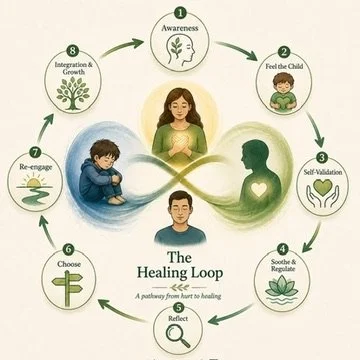
This is the movement from the Filial Loop to the Healing Loop.
The Inner Child was never foolish for building its original understanding of love. It was doing its best to make sense of the world it was given at that time. The Inner Critic was never simply an enemy either. It was trying to protect the Child using the only rules it had. But neither one needs to keep running your adult life. The task is not to reject these younger parts of yourself, but to build the internal resources that were missing, to listen to and soothe the Inner Child, understand the Inner Critic, develop the Nurturing Parent, and strengthen the Adult who can decide what belongs to yesterday and what is true today.
Perhaps the question changes from “Why do I keep choosing relationships like this?” to “What does this relationship awaken within me?” And perhaps “How do I stop feeling this?” becomes “Which part of me is feeling this?”, “What does it believe is happening?”, and “What does it need from me now?” These are not small shifts. They move us beyond managing symptoms and into relationship with ourselves, because healing is not achieved when the Inner Child never feels frightened again.
Healing happens when fear no longer means abandonment from within.
The Inner Child feels. The Nurturing Parent responds. The Adult protects and chooses, and the Inner Critic gradually lays down its old responsibility. Through thousands of these small internal moments, a new truth begins to form, one that says I no longer have to recreate the relationships that wounded me in order to resolve what happened within them. I can become the person my Inner Child needed then, and the person my adult self needs now.
That is the Healing Loop. And perhaps that is what it ultimately means to become yourself.