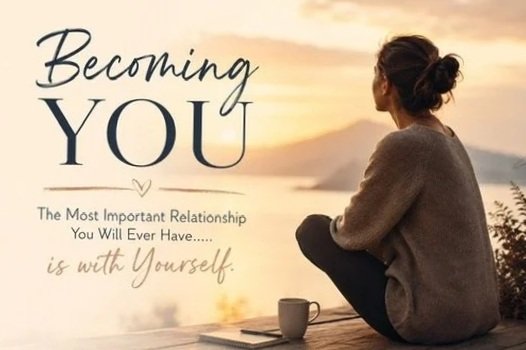
“Becoming You”
The Most Important Relationship You will ever have……is with Yourself.
This is an article about the art of building a relationship with yourself
Most of us spend our lives investing in relationships. We work at our marriages and friendships. We nurture our connections with our children, our colleagues, our communities. We read about how to communicate better, love more deeply, and understand the people around us. Entire industries exist to help us become better partners, better parents, better friends.
And yet there is one relationship that quietly shapes every other, and most of us have never given it any real attention at all.
The relationship we have with ourselves.
My soon to be published book, “Becoming You”, grew from a belief I have arrived at over many years of working as a therapist and identity coach. The belief is simple, but its implications reach into every corner of a life. The most important relationship you will ever have is the relationship you have with yourself. Every other relationship you have, the love you give, the love you allow yourself to receive, the boundaries you set or fail to set, the way you handle fear and disappointment and difficulty, is filtered through this one relationship. Tend to it, and everything else has the conditions it needs to grow. Neglect it, and you can work as hard as you like on everything else and still feel that something is not quite right.
I have sat with a great many people over the years who came to therapy believing their difficulty was external. A relationship that was not working. A career that had stalled. An anxiety that seemed to arrive from nowhere. And what I discovered, again and again, was that beneath the presenting issue was almost always the same underlying pattern. Not a lack of intelligence, or resilience, or good intention, but a relationship with the self that had never been properly built. People who had spent years learning to read everyone else’s needs while remaining almost entirely illiterate in their own.
Becoming You is the book I wished I could have handed to every one of them on the first day we met.
Not About Fixing Yourself
Let me say clearly what this book is not.
It is not about fixing yourself. We live in a culture saturated with the message that we need to be improved, upgraded, optimised. That who we currently are is a problem to be solved and who we might become, if only we tried hard enough, is the solution. I do not believe that. And in all my years of sitting with people in genuine difficulty, I have never found it to be a useful starting point for lasting change.
The people I work with are not broken. They are, almost without exception, people whose responses to their lives have made perfect sense given everything they have been through, even when those responses are causing them pain now. Becoming You is not about becoming someone different. It is about building a healthier, more honest, more compassionate relationship with the person you already are.
This distinction matters more than it might first appear, because it changes not only what you are working towards but how you approach the working. If the goal is to fix yourself, every difficult feeling becomes evidence of failure. Every setback confirms the suspicion that something is fundamentally wrong. But if the goal is relationship, the same difficult feeling becomes something else entirely. It becomes information. A message from a part of you that has been trying, often for years, to be heard.
I want to be honest about why this reframe matters so much, because it is not simply a gentler way of saying the same thing. The two approaches produce genuinely different outcomes. A person working to fix themselves tends to experience their own growth as a battle, one part of the self trying to defeat or suppress another. That battle is exhausting, and it rarely produces lasting change, because it treats the very parts of yourself that need understanding as obstacles to be overcome. A person building a relationship with themselves experiences growth differently. Not as conquest, but as the slow, patient work of coming to know someone more fully, the way any genuine relationship deepens over time.
The Filial Psyche
Running through the whole book is a model I have developed in my clinical work, which I call the Filial Psyche. It describes three parts of yourself that I think you will recognise the moment they are named, because you have been living alongside them, in varying degrees of harmony and conflict, for your entire life.
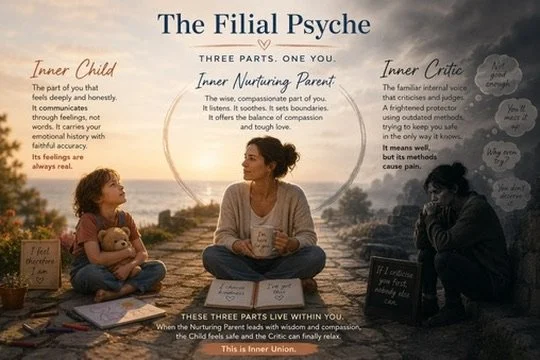
There is the Inner Child, the part of you that feels deeply and honestly, often before thinking has had a chance to catch up. It does not communicate through words.
S/he communicates through feelings, through the sudden tightness in your chest, the sadness that arrives without a clear explanation, the anxiety that appears before something that should, by most reasonable measures, feel entirely fine. It carries your emotional history with faithful accuracy, and its feelings, however inconvenient they sometimes seem, are always real, even when its interpretation of events is not entirely accurate.
There is the Inner Critic, the familiar internal voice that has been commenting on your performance for as long as you can remember. It is not your enemy, though it can certainly feel like one. It is, in the reframe I offer throughout the book, a frightened protector using outdated methods, trying in the only way it knows to keep you safe from being hurt again. Its logic runs something like this. If I criticise you first, nobody else can. If I stop you trying, you cannot fail. If I lower your expectations, you will not be disappointed. The Inner Critic does not realise, because it has never updated its assessment, that in pursuing these goals it has become the very source of the pain it was trying to prevent.
And there is the Inner Nurturing Parent, the wise, steady, compassionate voice within you that has the capacity to hold both of the others with genuine care. It is not something that needs to be imported from outside, borrowed from a therapist or a book or a wiser friend. It is already there, in every one of us, though for many people it has had far less practice than the critic and correspondingly less confidence in its own voice. Much of the work of Becoming You is learning to strengthen this voice, trust it, and gradually allow it to lead, not by silencing the critic through force but by outgrowing its authority through the steady accumulation of a different kind of evidence.
What makes this model useful, in my experience, is not its theoretical completeness. No model of the human interior could claim that. What makes it useful is that it gives people a practical, portable way of understanding their own inner conversation, one they can carry into an ordinary Tuesday afternoon and actually apply, in the middle of an argument or a difficult decision or a wave of unexplained sadness. Which voice is speaking right now? And which voice do I want to lead?
The Journey Through My Book
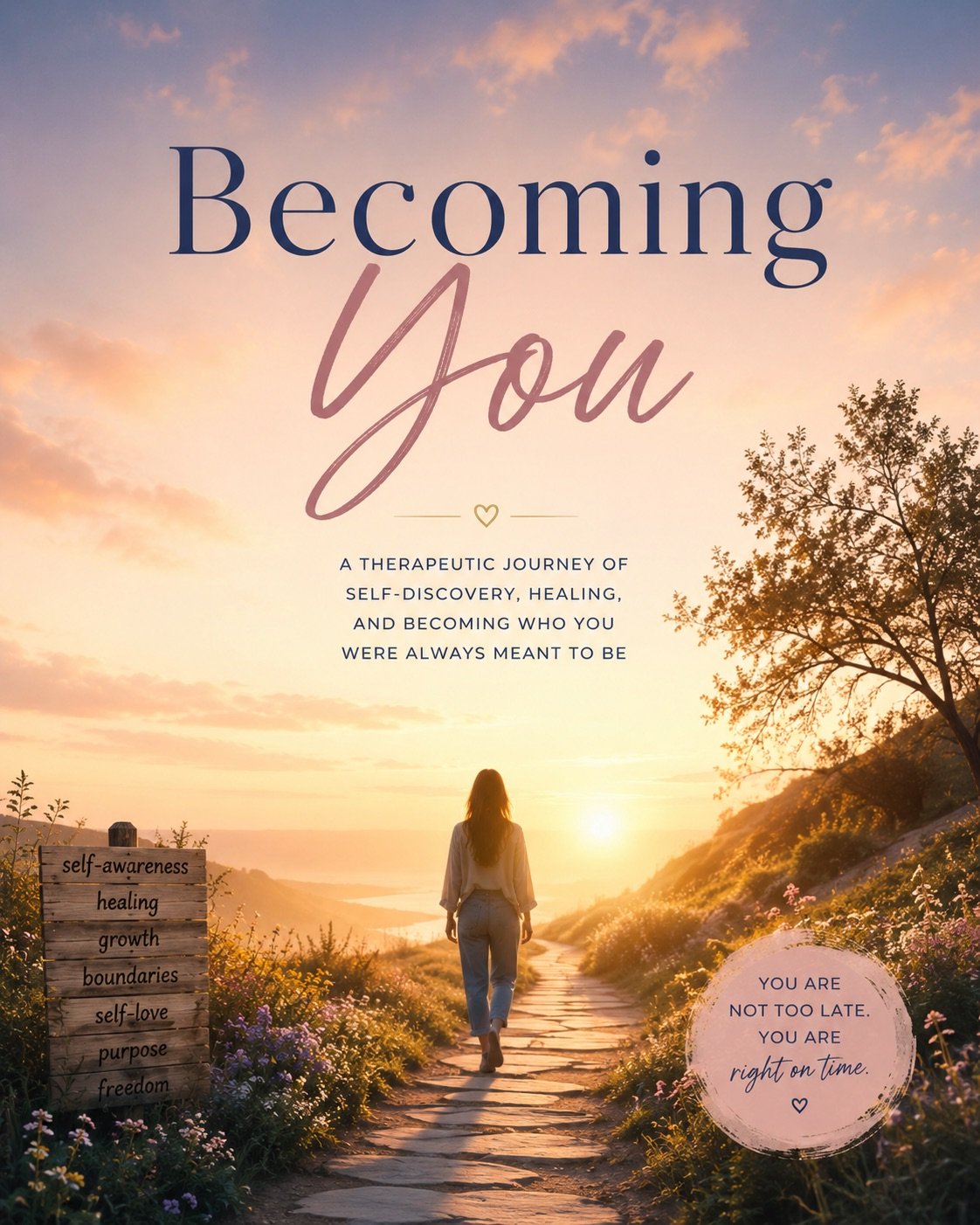
“Becoming You” unfolds across fourteen parts or chapters, each one building carefully on the one before, so that the reader is never asked to do work they have not been prepared for by what has come earlier.
We begin with getting to know yourself, because you cannot build a relationship with someone you have never truly met. Most of us spend years trying to change ourselves before we have taken the time to actually understand ourselves, which is, in a very real sense, backwards. The first step towards a healthier relationship with yourself is not change. It is curiosity. Before you can decide what you want to be different, you have to know what is actually there, without judgment getting there first.
From there we move into learning to listen to yourself, developing what I call self-attunement. Most people do not ignore themselves because they do not care. They ignore themselves because nobody ever taught them how to listen. This chapter distinguishes between soothing and escaping, and asks the reader to notice what happens when a difficult feeling arrives. Do you distract yourself immediately, or can you stay present long enough to hear what the feeling is actually saying? Every feeling, I suggest, is not a problem to be solved but a message to be received. Sadness says something mattered. Fear says something feels unsafe. Anger says a boundary may have been crossed.
Then comes trusting yourself again. Self-trust, I argue, is not the same as confidence, and the distinction matters enormously. Confidence depends on the situation, rising and falling with skill and circumstance. Self-trust is the deeper belief that whatever happens, you will not abandon yourself. This chapter traces how self-trust quietly erodes over years of ignoring our own instincts and seeking permission from others, and offers a path back through the accumulation of small kept promises.
There is a chapter on acceptance, which I consider one of the genuine emotional turning points of the whole book. Self-discovery, left alone, can easily curdle into self-criticism. Someone uncovers a pattern in themselves and instead of meeting it with understanding, concludes that they have simply found more evidence of what is wrong with them. Acceptance is what prevents that collapse. It says, this is where I am, and this is not where I have to stay. It is not approval of everything that happened to you, and it is not resignation to staying exactly as you are. It is the clear-eyed, compassionate acknowledgement of reality as the only solid ground from which genuine change becomes possible. We cannot change what we refuse to accept, and we rarely need to change what we have fully accepted.
We explore becoming your own safe person, learning to stop abandoning ourselves in the countless small ways we have made habitual, through overwork, through people-pleasing, through the quiet dismissal of our own needs. Emotional safety, I suggest, is not the absence of pain. It is knowing that whatever life brings, you will not leave yourself alone in it. Healing begins the moment you become the person who no longer leaves yourself alone in your pain.
We meet the Inner Critic directly, not as an enemy to be defeated but as a protector to be understood and gently relieved of a role it was never qualified to hold. This chapter reframes the critic’s harshness as a form of outdated loyalty, a strategy that once made sense and has simply never been updated. The goal is not to silence it. The goal is to outgrow it, allowing a wiser voice to take the lead instead.
We learn about re-parenting our emotional world, offering ourselves the steady, wise, compassionate care that healthy development requires and that many of us received only inconsistently. This is not about blaming the parents we had. It is about becoming, today, the parent our own emotional world has always needed. The greatest act of emotional maturity, I suggest, is not becoming independent of your Inner Child. It is becoming the adult your Inner Child can finally relax with.
We explore self-compassion without self-indulgence, because genuine kindness towards yourself includes honesty and accountability as well as comfort. Many people believe compassion means letting themselves off the hook, and many others believe growth only comes through criticism. Neither is true. Real self-compassion does not ask less of you. It simply asks without attacking you.
We look at boundaries, not as walls built to keep people out, but as honest expressions of who you are that allow other people to finally meet the real you. Every boundary, in the end, answers a single question. Will I abandon myself in order to keep this relationship? Learning to answer no to that question, consistently and with love, is one of the most significant developments this book describes.
We consider living according to your values, the deeper directions that give a life its meaning, distinct from the goals and achievements that so often crowd them out. Values are not goals you achieve. They are directions you choose to keep walking in. When your life reflects your values, you stop searching for yourself because you begin expressing yourself.
And we arrive, finally, at becoming the person your Inner Child needed. Not a perfect person. Not a finished one. But someone your younger self would have felt safe with. Someone who listens, who stays, who understands, who remains. Healing, in the end, is not the process of becoming someone your Inner Child would admire. It is the process of becoming someone your Inner Child can finally rest with.
A Practical Journey
Becoming You is not a book to be consumed quickly. Many people have spent years in conversation about themselves, through therapy, through reading, through reflection with trusted friends, and insight of that kind genuinely matters. But insight without practice rarely changes a life. You can understand exactly why you struggle with trust and still find yourself unable to trust. Understanding tells you where you are. Only practice can move you somewhere different.
For that reason, every part of the book contains three things working together. Ideas, offered as ways of looking at your own inner world rather than instructions to be followed. Reflection, the invitation to let those ideas meet your own particular experience honestly. And practical exercises, simple, repeatable practices that give the ideas somewhere to land in the reality of a daily life. The exercises are not homework. They are conversations with yourself, and they are where the real work happens. Each chapter also closes with a slightly deeper therapeutic exercise, of the kind I would use in a session, designed to be returned to rather than completed once and set aside.
There is no race here, and I say this directly in the book’s introduction because I think it matters more than almost anything else I could tell a reader. Some chapters will feel immediately familiar, as though you have been waiting for exactly this articulation of something you have long half-known. Others will feel genuinely uncomfortable, bringing you into contact with material that has been easier to avoid than to examine. Both experiences are entirely normal, and both are useful in their own way. What produces genuine, lasting change is not the speed at which you move through the material. It is the consistency with which you return to it, the willingness to keep showing up for the same quiet, ordinary practice of remaining present to yourself, day after day, long after the initial reading is finished.
Who This Book Is For
I wrote “Becoming You” for anyone who has ever sensed that something in their life was not quite adding up, even when, by most external measures, everything appeared to be going reasonably well. For the person who has spent years being available to everyone else’s needs while quietly losing track of their own. For anyone who has noticed a harsh, familiar internal voice and wondered whether it might, after all, simply be the truth about who they are. For anyone who has achieved a great deal and still felt, underneath it, a persistent sense of not being enough.
It is also, I hope, a book for people already familiar with therapeutic ideas, who are looking for a coherent framework that ties self-knowledge, self-compassion and daily practice together into something they can actually carry with them, rather than a collection of separate insights that never quite cohere into a whole life.
This is not a quick fix, and I would be doing you a disservice if I promised one. It is a companion for a genuinely important piece of work, one that unfolds gradually and rewards patience far more than urgency.
Coming Home
There is a particular kind of peace that becomes available once you stop trying to become someone else and begin, instead, learning to become more consistently and more honestly yourself. It does not arrive all at once, and it does not mean the end of difficulty. Storms still come. People still disappoint us. Mistakes still happen, including our own. What changes is not the weather. What changes is that you no longer have to face it alone, because the someone who stays, who listens, who remains present through the difficulty, has finally become you.
In the end, Becoming You was never about becoming someone else. It was always about coming home to the person you have been waiting for all along.
The relationship with yourself is the one relationship you will carry for every moment of your life. It will influence every decision you make, every relationship you build, every challenge you face and every joy you are able to fully receive. It deserves your honesty, your courage, and your compassion.
The greatest gift you can give yourself is not the pursuit of perfection. It is the quiet, daily, renewed commitment to remain in relationship with yourself, with honesty, courage and compassion, for the rest of your life.
Becoming You is available now. I hope it becomes a genuine companion on that journey, one you return to not because you have finished it, but because the relationship it describes is one worth tending for the whole of your life.