Who or What is your Inner Child?
What or Who is your Inner Child?
In my model of the psyche, there are two primary psychological entities: the inner child and the inner critic. A third—often underdeveloped or entirely absent in many clients—is the inner nurturing parent, which we will come to later. I call these three psychic entities, the Filial Psyche.
Let’s begin with a fundamental distinction.
The inner child is not a thinking or believing part of the psyche. It does not analyse. It does not judge. It does not form beliefs.
The inner child is an entity within our psyche that is a feeling system.

It is made up of emotional experiences, sensations, and bodily responses that originate in early life—long before cognitive processing is available. From as early as 12 to 18 months, the child is already having powerful emotional experiences, but without the neurological capacity to make sense of them.
At this stage, there is no ability to think, “This is rejection,” or “This is abandonment.” or “This isn’t fair”
There is only the feeling and bodily sensation or experience of it.
The most obvious emotional response being the survival response of flight - fight or freeze automatic and primitive brain responses.
This is why I deliberately use the word experience rather than belief. Abandonment, rejection, and injustice are not initially understood—they are felt. They are stored in the body and nervous system as raw, unprocessed emotional material.
The capacity for thinking—what we refer to as the inner critic—emerges later, typically between the ages of five and eight. This is when the child begins to interpret their earlier experiences and form beliefs about themselves, others, and the world.
These beliefs are not formed in isolation.
They are shaped—often profoundly—by parental influence, projection, and the relational environment in which the child develops.

So by the time the inner critic comes online, the inner child is already formed—already carrying unresolved emotional experiences that have not yet been understood, processed, or integrated.

This is where the relationship between these two parts becomes critical.
The inner child and the inner critic are distinct, but deeply interconnected. In many clients, they form a co-dependent dynamic that operates largely outside of conscious awareness.
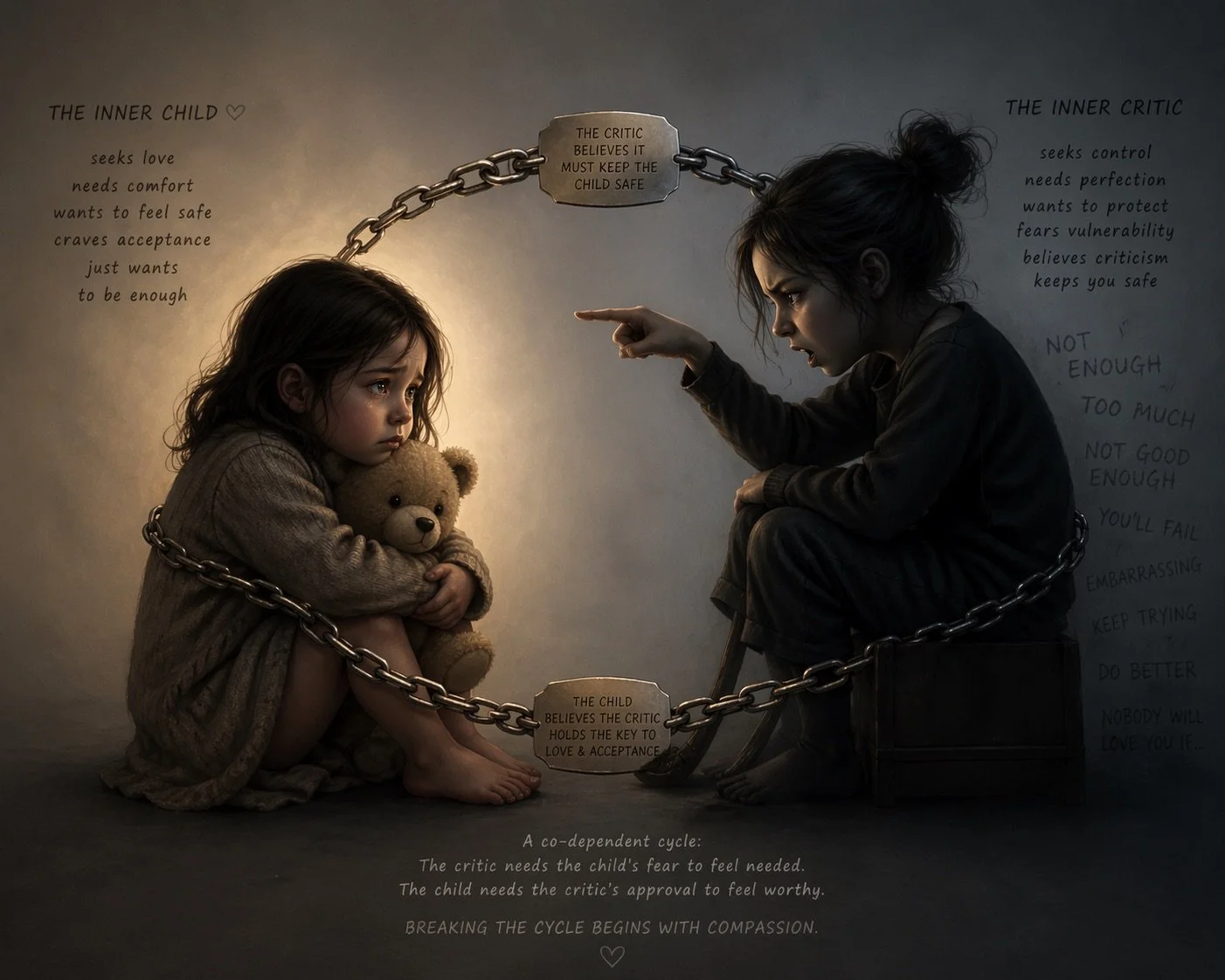
The role of the inner critic is not simply to criticise. Its deeper function is protective—but in a way that often keeps the psychological system stuck.
The inner critic attempts to prevent further emotional wounding. It does this by forming beliefs, creating rules, and anticipating threat based on past experience. However, in trying to protect the system, it also reinforces the very patterns that keep the original wound alive.
The inner critic attempts to prevent further wounding, but in doing so, it paradoxically perpetuates the original wound.
In other words, it preserves familiarity.
And the unconscious mind values familiarity above all else.
It does not prioritise happiness, fulfilment, or growth. It prioritises what is known—even if what is known is painful.
So the inner critic maintains established beliefs, and those beliefs continue to activate the emotional experiences held within the inner child. The result is a self-perpetuating cycle of thought and feeling that resists change.
This is why clients often say, “I know this isn’t rational, but I still feel it.”
Because the feeling belongs to the inner child, and the belief belongs to the inner critic—and both are working together to maintain a familiar internal reality.
As Carl Gustav Jung observed, until we make the unconscious conscious, these internal dynamics will continue to shape our lives without us fully understanding why.
This is where therapy begins.
And this is where inner child work becomes essential.
So What Happens When There Is No Inner Nurturing Parent?
If the inner child is the feeling system, and the inner critic is the thinking and belief system, then the inner nurturing parent is the regulating system.
It is the part of the psyche that can hold both.
It brings balance.
It provides perspective, compassion, and—crucially—boundaries.
However, in many of the clients I work with, this part is either significantly underdeveloped or entirely absent.
And this is not accidental.
The absence of an inner nurturing parent is, more often than not, a direct reflection of early relational experience.
Children do not learn how to soothe themselves in isolation. They learn it through being soothed.

They do not learn emotional regulation through instruction. They learn it through co-regulation.
In other words, the capacity to develop an inner nurturing parent comes from having experienced one externally.
When a child grows up in an environment where emotional needs are consistently met with attunement, care, and appropriate boundaries, they begin to internalise that relationship. Over time, this becomes an internal resource—a voice or presence that can reassure, guide, and contain emotional experience.
But when that environment is absent—or inconsistent, critical, neglectful, or emotionally unavailable—the child has nothing stable to internalise.
Instead of developing a nurturing internal presence, the child adapts.
And those adaptations often take the form of an overactive inner critic and a vulnerable, uncontained inner child.
The system becomes polarised.
The inner child continues to hold unresolved emotional experiences—abandonment, rejection, injustice—while the inner critic attempts to manage those experiences through control, avoidance, or self-judgement.
What is missing is the part that can sit between them.
The part that can say: “I understand why you feel this way, and you are safe now.”
Without an inner nurturing parent, the individual is left with two dominant internal forces: one that feels, and one that reacts to those feelings.
There is no mediator, to allow developmental learning to flourish.
No internal relationship that offers compassion with structure.
No voice that can both soothe the inner child and set limits on the inner critic.
This is why many clients experience either emotional overwhelm or emotional shutdown.
They are either flooded by the feelings of the inner child, or controlled and suppressed by the inner critic.
Often, they oscillate between the two.
From a therapeutic perspective, this is not dysfunction in the way it is often described. It is adaptation.
The psyche has organised itself in the only way it could, given the environment it developed within.
If a child was criticised, they internalise a critic.
If a child was ignored, they internalise absence or even emptiness.
If a child was emotionally unsafe, they internalise vigilance or hyper vigilance.
But if a child was not consistently nurtured, they do not internalise a nurturing presence.
And this is where therapy becomes transformative.
Because the development of the inner nurturing parent is not something that is “found”—it is something that is built.
Initially, this often happens within the therapeutic relationship itself.
The therapist models attunement, consistency, emotional regulation, and appropriate boundaries. Over time, the client begins to internalise this experience, gradually developing their own capacity to respond to themselves differently.
To respond with compassion rather than criticism.
With understanding rather than judgement.
With firmness rather than fear.
This is not about eliminating the inner critic.
Nor is it about “fixing” the inner child.
It is about creating a new internal relationship—one in which the inner nurturing parent can hold both parts in a way that allows for integration rather than conflict.
In many ways, this is the work.
As Carl Gustav Jung suggested, psychological growth is not about removing parts of ourselves, but about bringing them into relationship with one another in a more conscious and integrated way.
The inner nurturing parent is the part that makes that integration possible.
Without it, we remain caught between feeling and reaction.
With it, we begin to develop something far more powerful:
The capacity to belong to ourselves.
The science and the art of therapy is to re- parent the inner child. To push back on the inner critic and to model a burgeoning inner nurturing parent.
The journey from fragmentation of these psychic entities toward loving and compassionate integration and wholeness.