How Therapy creates positive change.
Healing the Inner Child. Challenging the Inner Critic and Empowering the inner Nurturing Parent.
One of the central principles that underpins my therapeutic work is the understanding that the past is not something we simply leave behind. Rather, it is something we continue to live out, often unconsciously, in the present. Clients frequently arrive in therapy wanting to know why life isn’t working for them. We may explore their past, to understand what happened to them and why they feel the way they do. Their story is important, and there are times when we will make connections with early experiences, particularly in relation to unhelpful parenting, attachment style, and the development of core beliefs. However, therapy is not about dwelling in the past. It is about recognising how the past is actively shaping our present experience.
What clients struggle with today—whether that is anxiety, low self-worth, relational difficulties, or a lack of direction—is rarely random. These experiences are patterned and form what therapists call a Life Script. They reflect an internal structure that has been formed over time and is now being repeated in real-life situations. The work of therapy is to bring this structure into awareness, so that it can be understood and, ultimately, changed.
A key distinction in my model is between two parts of the psyche: the inner child and the inner critic. This is an area that is often misunderstood in popular psychology. The inner child is frequently described as holding thoughts, beliefs, and emotions. However, this conflates two very different processes. In the way I work, the inner child does not think or analyse. It is the feeling part of the psyche. It holds emotional experiences, bodily sensations, and what we might call the emotional wounds of unmet needs—the need to feel seen, heard, safe, valued, and loved.
In contrast, the inner critic is the thinking part of the psyche. It develops in childhood as an adaptive response to early environments and relationships. It internalises (parental) messages about what is required in order to belong, to be accepted, and to remain safe. These negative messages eventually take the form of negative core beliefs such as “I am not good enough,” “I must not make mistakes,” or “I should not express my needs.”
The inner critic enforces these beliefs through judgment, doubt, and self-limiting and negative thoughts.
The difficulty arises because these two parts—the inner child and the inner critic—are rarely experienced as separate. Instead, they become fused together in what I refer to as the fused psychic self. This fusion is largely unconscious. As a result, when a person feels anxious, ashamed, or inadequate, they do not experience this as a combination of feeling and belief. They experience it as a singular truth about themselves. For example, a feeling of vulnerability in the inner child becomes immediately interpreted by the inner critic as “I am not good enough.” The individual does not see this as a pattern; they experience it as reality.
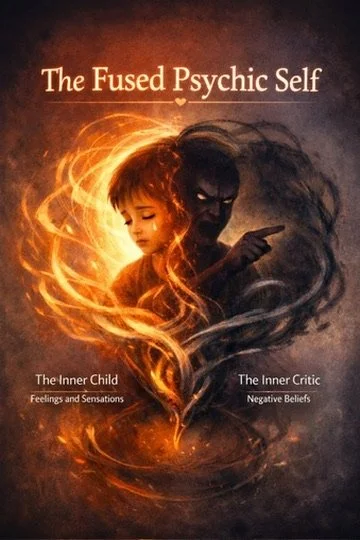
Understanding this fusion is crucial, because it explains why people feel stuck. The inner critic is not simply generating negative thoughts; it is maintaining a familiar emotional baseline. If a person’s early experiences were characterised by feelings of insecurity, rejection, or inadequacy, then these states become internalised as what is “normal.” The inner critic then works to preserve this familiarity, even when it is painful or limiting. It does so by disempowering the inner child by recreating and reinforcing its unmet needs. When the inner child seeks expression, connection, or growth, the inner critic intervenes with messages designed to inhibit those impulses. In this way, the system becomes self-reinforcing.
Clients are often unaware of these dynamics when they first enter therapy. They tend to describe their difficulties in terms of surface-level problems: repeated relationship issues, procrastination, lack of confidence, or a general sense of being stuck. The role of the therapist is to help the client identify the underlying patterns that give rise to these experiences. This is done not through abstract analysis, but through careful attention to present-moment experience. By exploring what the client is feeling, what they are telling themselves about that feeling, and how they subsequently behave as a result of those emotions, we begin to map the sequence that maintains the underlying pattern.
This sequence can be understood as an unconscious cycle of feeling, thought, behaviour, and outcome. The inner child generates the feeling, the inner critic interprets it through belief, the individual responds behaviourally, and the outcome reinforces the original belief. Over time, this cycle becomes entrenched, creating a self-fulfilling pattern.
A significant moment in therapy occurs when the client begins to recognise this pattern. They may say, “I can see what I’m doing now,” or “I understand where this comes from.” While this awareness is an important step, it is not sufficient in itself to create change. Almost inevitably, progress is met with resistance. This resistance is not a sign of failure; it is a function of the same system that has been maintaining the pattern. The inner critic, whose role is to preserve familiarity, responds to the prospect of change with increased intensity. It may generate doubt, fear, or avoidance, effectively pulling the individual back into old behaviours.
Working through this resistance requires a careful and measured approach. Rather than attempting to make large, overwhelming changes, therapy focuses on small, manageable steps. These “mini challenges” are designed to gently disrupt the pattern without triggering excessive resistance. For example, a client might be encouraged to express a single honest thought, set a minor boundary, or take a small action despite feeling uncertain. These interventions are not merely behavioural; they are experiential. Each time the client acts differently, they create a new emotional experience that begins to challenge the old pattern. They will explore, perhaps through compassionate journaling, their emotional responses to this mini challenge experience. Observing their behaviour, whilst exploring any connections with early negative or limiting beliefs.
Central to this process is the development of what I refer to as the inner nurturing parent. This is the part of the psyche that can respond to the inner child with empathy, compassion, and understanding, while also setting appropriate limits with the inner critic. In the early stages of therapy, this function is often modelled by the therapist, akin to an act of reparenting. Through the therapeutic relationship, the client experiences being seen, heard, and valued, often in ways that were not available to them previously. At the same time, the therapist may gently confront resistance, helping the client to recognise and challenge the influence of the inner critic.
Over time, the client begins to internalise this nurturing stance. They develop the capacity to differentiate between feeling and belief, to support their inner child, and to question the authority of the inner critic. This marks the transition from the fused self to what I describe as the healthy filial psyche.

In the healthy filial psyche, the inner child is no longer overwhelmed or disempowered. It feels safe, supported, and able to express its needs. The inner critic, while still present, becomes less dominant and more balanced. It may retain a protective function, but it no longer dictates behaviour or undermines the individual’s sense of self. Most importantly, the nurturing parent takes on a leading role, providing a stable and compassionate internal framework.
The goal of therapy, therefore, is not to eliminate parts of the psyche, but to transform the relationship between them. It is about bringing unconscious patterns into awareness, separating what has become psychically fused, and creating the conditions for a new way of being. When this internal shift occurs, it is reflected in external positive changes to our relationships, in our behaviour, and in the overall experience of life.
Ultimately, the work is about moving from a life governed by unconscious repetition to one guided by conscious choice. It is about recognising that the patterns which once served a protective function, in childhood, will no longer be necessary, and that it is possible to respond to life from a place of greater awareness, flexibility, and self-compassion.